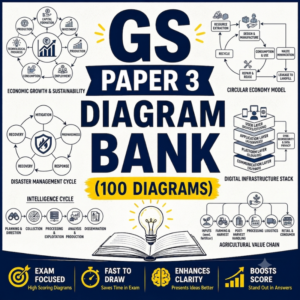
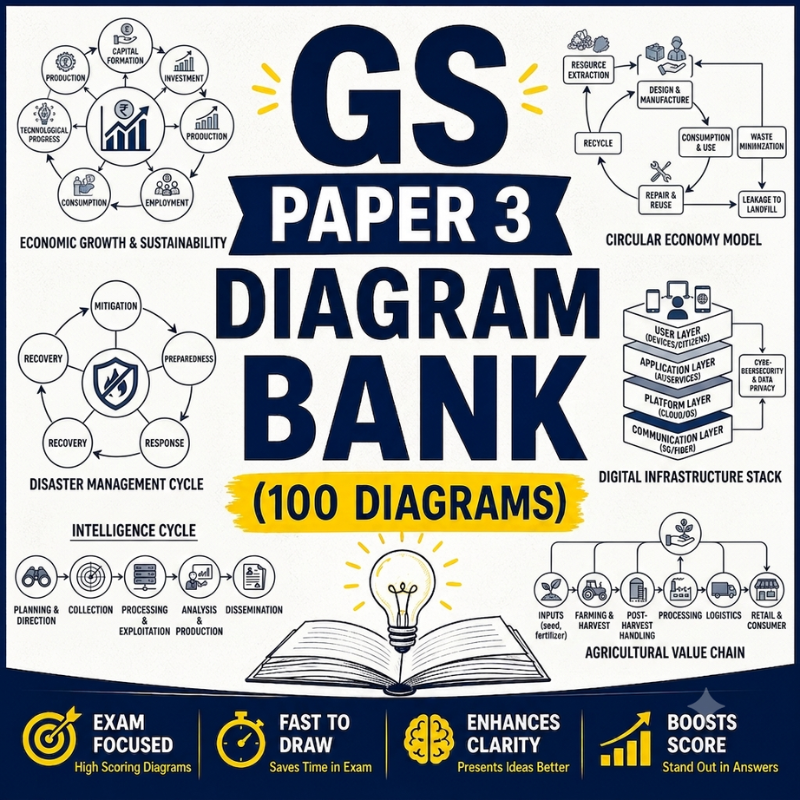

UPSC GS Paper-III is one of the most dynamic and analytical papers in the Mains examination, covering subjects such as the Indian economy, agriculture, science and technology, environment, internal security and disaster management.
High scores in GS Paper-III require not only strong content but also the ability to present interlinkages, processes and solutions in a clear and structured manner.
These hand-drawn diagrams have been specially designed to transform your answers from descriptive to analytical within seconds.
Whether it is explaining economic growth models, climate change, the disaster management cycle, food security, AI and emerging technologies, internal security challenges or sustainable development frameworks, a simple diagram can communicate multiple dimensions more effectively than lengthy paragraphs.
Most diagrams can be drawn within 20–40 seconds during the examination, helping you save time while enhancing the visual appeal and content density of your answers.
They can be strategically used in the introduction to explain concepts, in the body to present causes, impacts and policy linkages, or in the conclusion to provide solution-oriented frameworks and a way forward.
UPSC examiners reward clarity, structure and multidimensional thinking, and diagrams are among the most effective tools to demonstrate all three.
By mastering these diagrams, you will improve answer presentation, write faster under exam pressure and significantly enhance your scoring potential in General Studies Paper-III.
Diagrams on following 100 topics are available:
1. Inclusive Growth
2. Economic Growth vs Development
3. Indian Economy Framework
4. Macroeconomic Stability
5. Fiscal Policy
6. Monetary Policy
7. Inflation
8. Unemployment
9. Poverty
10. Financial Inclusion
11. MSMEs
12. Banking Sector Reforms
13. NPAs
14. Capital Markets
15. Tax Reforms
16. Public Finance
17. Disinvestment
18. Startup Ecosystem
19. Gig Economy
20. Digital Economy
21. Blue Economy
22. Green Economy
23. Circular Economy
24. Infrastructure Development
25. Logistics Sector
26. Investment and Savings
27. Employment Generation
28. Sustainable Development
29. Ease of Doing Business
30. Demographic Dividend
31. Indian Agriculture Framework
32. Agricultural Productivity
33. Crop Diversification
34. Food Security
35. MSP
36. Agricultural Marketing
37. Natural Farming
38. Organic Farming
39. Climate Smart Agriculture
40. Precision Farming
41. Irrigation
42. PM-KISAN
43. Agricultural Infrastructure
44. Farmer Producer Organisations
45. Agri-Startups
46. Post Harvest Management
47. Agricultural Supply Chains
48. Land Reforms
49. Livestock Economy
50. Blue Revolution and Fisheries
51. Artificial Intelligence
52. Machine Learning
53. Quantum Computing
54. Semiconductor Mission
55. Biotechnology
56. Gene Editing
57. Space Technology
58. ISRO Missions
59. 5G and Future Networks
60. Robotics
61. Nanotechnology
62. Cyber Physical Systems
63. Blockchain
64. Cloud Computing
65. Internet of Things
66. Green Hydrogen
67. Energy Storage Technologies
68. Digital Public Infrastructure
69. Nuclear Technology
70. Emerging Technologies Governance
71. Climate Change
72. Net Zero
73. Carbon Markets
74. Biodiversity Conservation
75. Ecosystem Restoration
76. Pollution Control
77. Waste Management
78. Renewable Energy
79. Energy Security
80. Disaster Resilient Infrastructure
81. Land Degradation
82. Water Security
83. Sustainable Consumption
84. Environmental Governance
85. Circular Economy in Environment
86. Internal Security Challenges
87. Cyber Security
88. Border Management
89. Terrorism
90. Organised Crime
91. Money Laundering
92. Drone Technology
93. Artificial Intelligence and Security
94. Critical Infrastructure Protection
95. Data Protection
96. Maritime Security
97. Left Wing Extremism
98. National Security Architecture
99. Hybrid Warfare
100. Disaster Management and Security