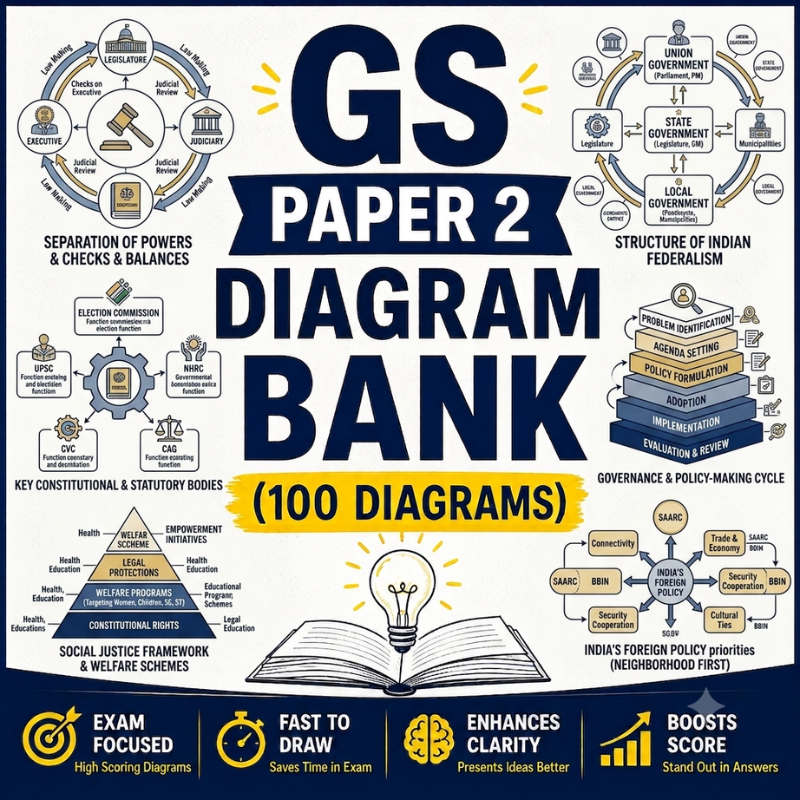

UPSC GS Paper-II demands multidimensional analysis of topics such as the Constitution, governance, Parliament, judiciary, social justice, international relations and public policy. Merely writing lengthy answers is rarely sufficient to secure top marks.
What distinguishes high-scoring copies is the ability to present complex constitutional and governance issues in a simple, structured and analytical manner.
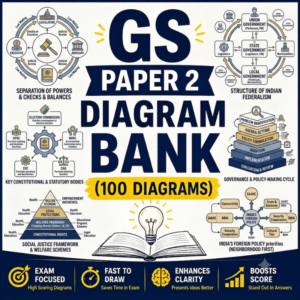
These hand-drawn diagrams have been specially designed to help you achieve exactly that. Whether it is explaining the separation of powers, federalism, welfare schemes, pressure groups, governance models, India’s foreign policy or international organisations, a well-placed diagram can make your answer stand out instantly.
Most of these diagrams can be drawn within 20–40 seconds, saving valuable time while increasing the content value of your answers. You can use them in the introduction to define concepts, in the body to explain institutional linkages, causes, challenges and reforms, or in the conclusion to suggest a way forward.
A single governance framework or constitutional flowchart can effectively convey multiple dimensions that may otherwise require several paragraphs.
These diagrams not only improve presentation but also demonstrate conceptual clarity and analytical thinking—qualities highly valued by UPSC examiners.
Regular practice will enable you to write faster, present richer answers and maximise your score in General Studies Paper-II.
Diagrams on following 100 topics are available in this:
1. Basic Structure Doctrine
2. Preamble
3. Constitutionalism
4. Separation of Powers
5. Checks and Balances
6. Parliamentary Democracy
7. Federalism
8. Cooperative Federalism
9. Competitive Federalism
10. Asymmetric Federalism
11. Centre-State Relations
12. Inter-State Relations
13. Governor’s Office
14. President of India
15. Prime Minister and Council of Ministers
16. Parliament and Legislative Process
17. Parliamentary Committees
18. Judicial Review
19. Judicial Activism
20. Judicial Reforms
21. Tribunals
22. Election Commission
23. Electoral Reforms
24. Anti-Defection Law
25. Local Self Government
26. 73rd Constitutional Amendment
27. 74th Constitutional Amendment
28. Decentralisation
29. Constitutional Bodies
30. Statutory Bodies
31. Quasi Judicial Bodies
32. Constitutional Amendments
33. Emergency Provisions
34. Fundamental Rights
35. Directive Principles and Fundamental Duties
36. Good Governance
37. Citizen Centric Governance
38. Minimum Government Maximum Governance
39. Transparency
40. Accountability
41. Responsiveness
42. Participatory Governance
43. Digital Governance
44. E-Governance
45. SMART Governance
46. Civil Services Reforms
47. Mission Karmayogi
48. Public Service Delivery
49. Social Audits
50. Citizen Charter
51. RTI
52. Whistleblower Protection
53. Grievance Redressal
54. Administrative Reforms
55. Outcome Based Governance
56. Ease of Living
57. Ease of Doing Business
58. Inclusive Governance
59. Performance Based Governance
60. Evidence Based Policymaking
61. Education
62. Health
63. Nutrition
64. Women Empowerment
65. Gender Budgeting
66. Child Rights
67. Senior Citizens
68. Persons with Disabilities
69. SC Welfare
70. ST Welfare
71. OBC Welfare
72. Minority Welfare
73. Poverty Alleviation
74. Skill Development
75. Employment Generation
76. Human Development
77. Financial Inclusion
78. Digital Inclusion
79. Social Security
80. Inclusive Growth
81. India’s Foreign Policy
82. Neighbourhood First Policy
83. Act East Policy
84. Global South
85. Strategic Autonomy
86. Multilateralism
87. India and United Nations
88. India and G20
89. India and QUAD
90. India and BRICS
91. India-US Relations
92. India-Russia Relations
93. India-EU Relations
94. India-China Relations
95. India-Japan Relations
96. India-Africa Relations
97. India-Middle East Relations
98. Indian Diaspora
99. Development Partnerships
100. Climate Diplomacy