
UPSC GS Paper-IV (Ethics, Integrity and Aptitude) offers one of the best opportunities to score exceptionally well in the Mains examination. However, high marks are awarded not merely for writing definitions but for presenting ethical concepts in a structured, practical and multidimensional manner.
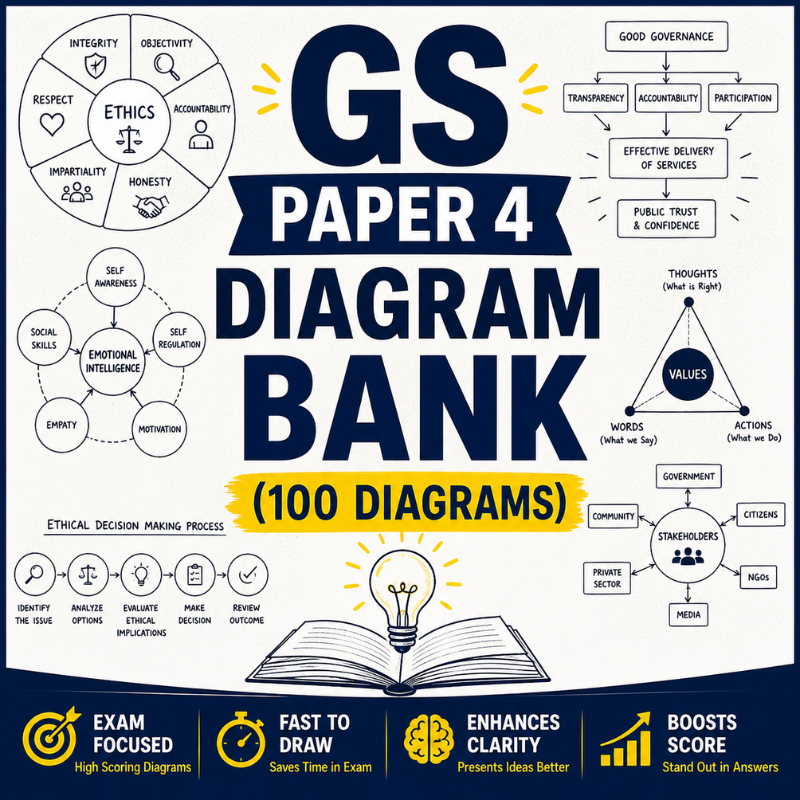
These hand-drawn diagrams have been specially designed to help you simplify complex topics such as ethics, emotional intelligence, aptitude, integrity, accountability, public service values, moral philosophy, governance ethics and case studies into easy-to-understand visual frameworks.
A well-drawn ethics diagram instantly enhances the presentation of your answer and reflects conceptual clarity before the examiner even reads the entire response. Most diagrams can be reproduced within 20–30 seconds, making them highly effective in a time-bound examination.
You can use them in the introduction to define ethical concepts, in the body to explain stakeholders, ethical dilemmas, causes and solutions, or in the conclusion to present value-based and solution-oriented approaches.
Diagrams such as the Ethics Wheel, Stakeholder Framework, Emotional Intelligence Model and Good Governance Framework can help you write richer and more analytical answers with minimal effort.
UPSC examiners particularly appreciate answers that are clear, innovative and application-oriented.
By mastering these diagrams, you will improve the quality of your ethics answers, save valuable time and substantially enhance your chances of securing top marks in GS Paper-IV.
Diagrams on following 100 topics are available:
(ETHICS AND HUMAN VALUES)
1. Ethics and Human Values
2. Dimensions of Ethics
3. Sources of Ethics
4. Determinants of Ethics
5. Ethics in Private and Public Life
6. Human Values
7. Moral Values
8. Universal Human Values
9. Indian Ethical Thinkers
10. Western Ethical Thinkers
11. Moral Development
12. Ethical Decision Making
13. Moral Reasoning
14. Integrity
15. Honesty
16. Compassion
17. Empathy
18. Tolerance
19. Non-violence
20. Selflessness
21. Responsibility
22. Accountability
23. Justice
24. Trust
25. Altruism
(ATTITUDE AND EMOTIONAL INTELLIGENCE)
26. Attitude
27. Components of Attitude
28. Functions of Attitude
29. Attitude Formation
30. Attitude Change
31. Behavioural Change
32. Emotional Intelligence
33. Components of EI
34. EI in Governance
35. Social Intelligence
36. Conflict Resolution
37. Stress Management
38. Leadership
39. Transformational Leadership
40. Ethical Leadership
41. Team Building
42. Persuasion
43. Negotiation
44. Communication Skills
45. Interpersonal Relationships
(CIVIL SERVICES VALUES)
46. Civil Service Values
47. Integrity in Public Service
48. Objectivity
49. Impartiality
50. Non-Partisanship
51. Dedication to Public Service
52. Commitment to Constitution
53. Political Neutrality
54. Public Trust
55. Responsiveness
56. Empathy in Administration
57. Compassion in Governance
58. Professionalism
59. Ethical Competence
60. Code of Conduct
61. Code of Ethics
62. Ethical Competence of Civil Servants
63. Ethical Leadership in Administration
64. Citizen-Centric Administration
65. Public Accountability
(PROBITY AND GOVERNANCE)
66. Probity in Governance
67. Transparency
68. Accountability
69. Corruption
70. Ethical Governance
71. Good Governance
72. RTI
73. Citizen Charter
74. Social Audit
75. Whistleblower Protection
76. Public Service Delivery
77. Ethical Decision Making
78. Public Resource Management
79. Administrative Ethics
80. Ethics in Public Institutions
81. Institutional Integrity
82. Ethical Public Policies
83. Conflict of Interest
84. Corporate Governance
85. Ethical Challenges in Governance
(CASE STUDIES)
86. Ethical Dilemmas
87. Stakeholder Analysis
88. Conflict Resolution Framework
89. Utilitarian Approach
90. Deontological Approach
91. Virtue Ethics
92. Consequentialism
93. Ethical Decision Making Models
94. Administrative Dilemmas
95. Leadership Dilemmas
96. Corruption Case Studies
97. Public Service Dilemmas
98. Policy Dilemmas
99. Citizen-State Conflict
100. Value-Based Administration