
Sale!

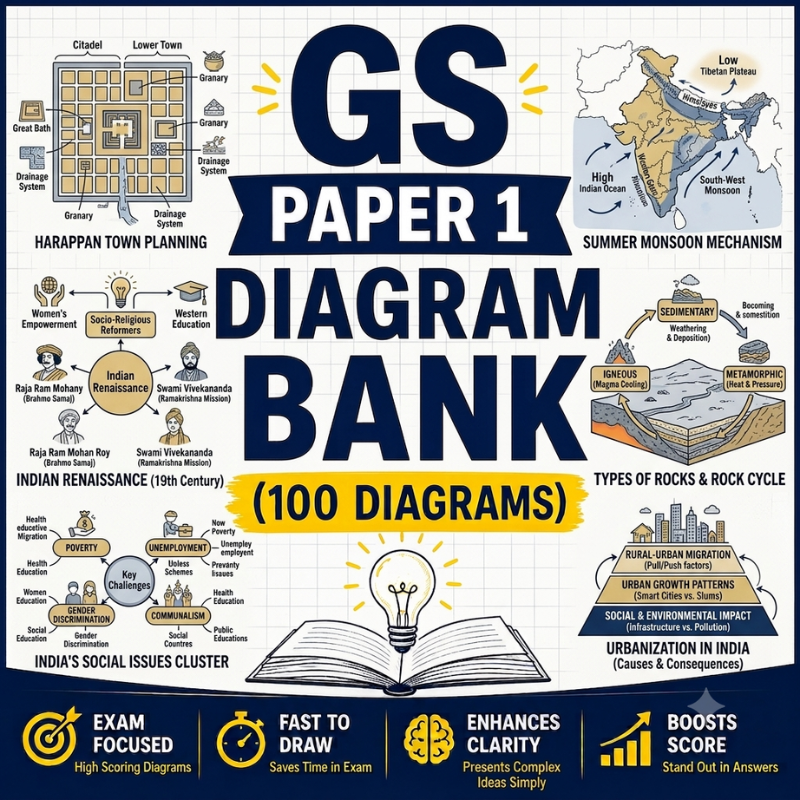
GS Paper 1 Diagram Bank (100 Diagrams)

Original price was: ₹1,000.00.Current price is: ₹299.00.

Category:
The difference between an average UPSC Mains answer and a top-scoring answer is often presentation. Examiners evaluate hundreds of copies every day, and a well-drawn diagram immediately captures attention, improves readability and demonstrates conceptual clarity.
These 100+ hand-drawn diagrams are designed specifically for UPSC GS Paper-I and can be reproduced in less than 30–40 seconds during the examination.
They help you present complex ideas such as social issues, geography, history and world events in a concise and structured manner without consuming valuable writing time.
Even if you are unable to recall every point, a relevant diagram can help you communicate multiple dimensions of an answer effectively. Use these diagrams strategically in your introduction to define a concept, in the body to explain causes, effects, linkages and processes, or in the conclusion to present solutions and a forward-looking perspective.
A single diagram can replace 60–80 words while making your answer more analytical and visually appealing.
Toppers consistently use flowcharts, frameworks and models because they improve content density and examiner engagement.
Mastering these diagrams will help you write multidimensional answers faster, enhance presentation quality and significantly improve your chances of securing higher marks in UPSC Mains.
Diagrams on following 100 topics are available:

1. Indus Valley Civilization
2. Urban Planning of Harappan Civilization
3. Vedic Society
4. Mahajanapadas
5. Buddhism and Jainism
6. Mauryan Administration
7. Gupta Age
8. Sangam Age
9. Bhakti Movement
10. Sufi Movement
11. Temple Architecture
12. Indo-Islamic Architecture
13. Mughal Administration
14. Mughal Art & Culture
15. European Arrival in India
16. Revolt of 1857
17. Socio-Religious Reform Movements
18. Freedom Struggle Timeline
19. Gandhian Philosophy
20. Moderate and Extremist Phase
21. Revolutionary Movement
22. Women in Freedom Struggle
23. Tribal Movements
24. Constitutional Developments
25. Contributions of Leaders
26. Salient Features of Indian Society
27. Unity in Diversity
28. Diversity of India
29. Women’s Empowerment
30. Female Labour Force Participation
31. Education and Social Transformation
32. Population Issues
33. Demographic Dividend
34. Urbanisation
35. Migration
36. Poverty
37. Globalisation and Indian Society
38. Secularism
39. Communalism
40. Regionalism
41. Caste System
42. Social Empowerment
43. Social Justice
44. Role of Family
45. Marriage Institution
46. Changing Values in Society
47. Digital Divide
48. Youth Issues
49. Ageing Population
50. Social Capital
51. Interior of Earth
52. Plate Tectonics
53. Volcanoes
54. Earthquakes
55. Mountain Formation
56. Rock Cycle
57. Geomorphology
58. Ocean Currents
59. Cyclones
60. Monsoon Mechanism
61. Jet Streams
62. ENSO
63. Climate Change
64. Natural Resources
65. Water Resources
66. River Systems
67. Himalayan Geography
68. Indian Drainage System
69. Soils of India
70. Agriculture of India
71. Mineral Resources
72. Industrial Location Factors
73. Disaster Management Framework
74. Urban Floods
75. Desertification
76. Biodiversity Hotspots
77. Land Degradation
78. Blue Economy
79. Renewable Resources
80. Sustainable Development
81. American Revolution
82. French Revolution
83. Industrial Revolution
84. Russian Revolution
85. World War I
86. World War II
87. Colonialism
88. Capitalism vs Socialism
89. Decolonisation
90. Globalisation
91. Causes-Effects-Solutions Triangle
92. Stakeholder Diagram
93. Women Empowerment Wheel
94. Inclusive Development Model
95. SDG Framework
96. Social Transformation Cycle
97. Urbanisation Framework
98. Disaster Management Cycle
99. Sustainable Development Triangle
100. Demographic Dividend Model

Scroll to Top