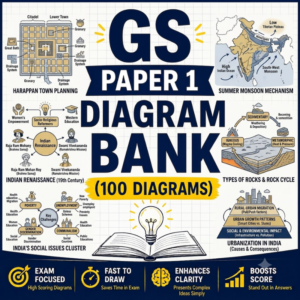

Diagrams for Sociology Optional subject on following 100 topics are available in PDF.
Paper I — Fundamentals of Sociology
1. Nature, Scope and Subject Matter of Sociology
2. Sociology and Common Sense
3. Sociology and Other Social Sciences: Political Science, Economics, History and Anthropology
4. Sociology as a Science: Objectivity, Value Neutrality and Scientific Method
5. Positivism, Interpretivism and Critical Sociology
6. Fact–Value Distinction and Ethical Neutrality in Sociological Research
7. Research Methods: Quantitative and Qualitative Approaches
8. Techniques of Data Collection: Survey, Questionnaire and Interview
9. Participant Observation, Ethnography and Case Study
10. Hypothesis, Sampling, Reliability and Validity
11. Social Statistics and Interpretation of Sociological Data
12. Objectivity, Reflexivity and Positionality in Research
13. Comparative Method and Historical Sociology
14. Social Research: Theory, Methods and Methodological Debates
15. Challenges of Studying a Complex and Diverse Society
Section B: Sociological Thinkers
16. Auguste Comte: Positivism, Law of Three Stages and Hierarchy of Sciences
17. Émile Durkheim: Social Facts, Their Characteristics and Methodological Rules
18. Durkheim: Division of Labour, Mechanical and Organic Solidarity
19. Durkheim: Suicide, Social Integration and Social Regulation
20. Durkheim: Religion, Collective Conscience and Collective Effervescence
21. Karl Marx: Historical Materialism and Modes of Production
22. Marx: Class Struggle, Alienation and Exploitation
23. Marx: Base–Superstructure Relationship and Ideology
24. Marx: Capitalism, Commodification and Class Consciousness
25. Max Weber: Social Action and Types of Social Action
26. Weber: Ideal Types, Verstehen and Value Relevance
27. Weber: Authority, Bureaucracy and Rationalisation
28. Weber: Class, Status and Party—Multidimensional Stratification
29. Weber: Protestant Ethic and the Spirit of Capitalism
30. Talcott Parsons: Social System, Social Action and AGIL Framework
31. Robert K. Merton: Manifest and Latent Functions, Dysfunction and Middle-Range Theory
32. Merton: Reference Groups, Relative Deprivation and Anomie
33. Mead: Self, Mind and Society; I and Me
34. C. H. Cooley: Looking-Glass Self and Primary Groups
35. Pierre Bourdieu: Habitus, Cultural Capital and Social Reproduction
Section C: Stratification, Institutions and Social Change
36. Social Stratification: Functionalist, Marxist and Weberian Perspectives
37. Social Mobility: Types, Determinants and Mobility in Modern Societies
38. Class, Status, Power and Social Inequality
39. Gender Stratification and Feminist Theories
40. Race, Ethnicity, Caste and Other Forms of Stratification
41. Family: Structure, Functions and Changing Forms
42. Marriage, Kinship, Descent and Rules of Residence
43. Religion: Sociological Theories, Secularisation and Religious Revivalism
44. Economy and Society: Social Organisation of Economic Life
45. Political Sociology: Power, Authority, Legitimacy and Elites
46. Education as an Institution: Socialisation, Inequality and Social Mobility
47. Work and Economic Life: Formal and Informal Organisation
48. Social Change: Evolutionary, Cyclical and Conflict Theories
49. Modernisation, Development and Dependency Perspectives
50. Globalisation, Information Technology and Social Transformation
Paper II — Indian Society: Structure and Change
Section D: Perspectives on Indian Society
51. G. S. Ghurye: Caste, Race, Tribes and Indian Culture
52. M. N. Srinivas: Sanskritisation, Westernisation and Secularisation
53. M. N. Srinivas: Dominant Caste and the Study of Village India
54. A. R. Desai: Marxist Interpretation of Indian Society and Nationalism
55. André Béteille: Caste, Class and Power in Indian Society
56. Louis Dumont: Homo Hierarchicus, Purity and Pollution
57. Yogendra Singh: Modernisation of Indian Tradition
58. Irawati Karve: Kinship Organisation in India
59. D. P. Mukerji: Tradition, Modernity and Indian Social Change
60. Indological, Structural-Functional and Marxist Approaches to Indian Society
Section E: Social Structure of Indian Society
61. Caste System: Origin, Features, Functions and Changing Nature
62. Caste and Class: Continuity, Mobility and Interrelationships
63. Caste in Politics and Politics in Caste
64. Untouchability, Caste Discrimination and Social Exclusion
65. Other Backward Classes, Dalit Assertion and Reservation
66. Tribal Communities: Distribution, Diversity and Social Organisation
67. Tribal Integration, Assimilation, Autonomy and Development
68. Tribal Displacement, Land Alienation and Forest Rights
69. Agrarian Class Structure, Land Reforms and Rural Inequality
70. Rural Social Structure: Caste, Kinship, Factionalism and Power
71. Urban Social Structure: Migration, Slums and Informal Settlements
72. Indian Family: Joint and Nuclear Families, Continuity and Change
73. Marriage, Kinship and Changing Patterns of Family Relationships
74. Religion, Communalism, Secularism and Religious Pluralism
75. Linguistic, Religious and Cultural Diversity: Integration and Conflict
Section F: Social Change, Movements and Contemporary Issues
76. Colonialism and Its Impact on Indian Society
77. Industrialisation, Urbanisation and Their Social Consequences
78. Globalisation and Its Impact on Indian Society and Culture
79. Modernisation, Westernisation and the Transformation of Indian Traditions
80. Democratisation, Political Participation and Social Change
81. Social Movements: Theories, Ideology, Organisation and Leadership
82. Peasant Movements and Agrarian Struggles in India
83. Tribal Movements and Indigenous Identity Assertion
84. Dalit Movements, Anti-Caste Struggles and Social Justice
85. Women’s Movements and Feminist Struggles in India
86. Ethnic Movements, Regionalism and Subnational Identities
87. Religious Movements, Communal Mobilisation and Identity Politics
88. Population Growth, Demographic Transition and Population Policies
89. Ageing, Changing Age Structure and the Demographic Dividend
90. Migration, Diaspora and Changing Patterns of Social Relations
91. Gender Inequality, Patriarchy and Women’s Empowerment
92. Violence Against Women, Gender-Based Discrimination and Social Institutions
93. Poverty, Unemployment, Inequality and Social Exclusion
94. Education, Digital Divide and Unequal Access to Opportunities
95. Development-Induced Displacement, Rehabilitation and Resettlement
96. Environmental Movements, Ecology and Society
97. Science, Technology, Digitalisation and Social Transformation
98. Mass Media, Social Media and the Transformation of Public Life
99. Challenges of Nation-Building: Diversity, Identity and Social Cohesion
100. Social Justice, Welfare Policies and the Changing Role of the State